

In modern product design, plastic assemblies are replacing metal housings due to their lower cost and ease of molding. However, one major challenge remains: creating strong, reliable threads within plastic parts.
That’s where threaded metal inserts come in — and more specifically, brass threaded inserts, which are widely used in injection-molded thermoplastics to ensure strength, reusability, and long-term product reliability.
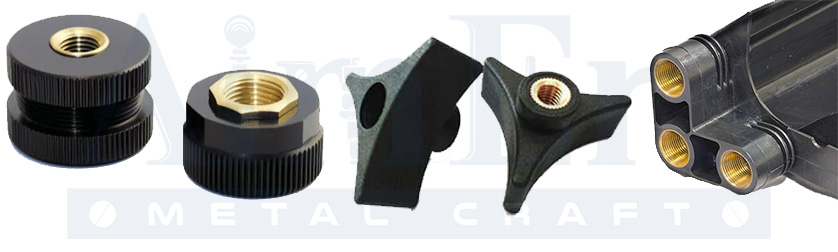
Threaded metal inserts are essential components for reinforcing plastic parts, especially in industries like automotive, electronics, and home appliances.
At Aimers Metal Craft, we manufacture custom threaded brass inserts for plastic, engineered to perform in high-stress environments, with precise knurling and tolerances.
🔩 1. High Pull-Out and Torque Resistance
Threaded inserts significantly improve pull-out strength (resistance to axial load) and torque resistance (rotational stress) compared to molded or tapped plastic threads.
When installed correctly — especially using heat staking or ultrasonic insertion — inserts anchor themselves into the plastic using their knurled or helical profile, ensuring a firm mechanical lock.
Why brass excels:
Brass is strong, rigid, and allows for sharp knurl patterns which bite into plastic without cracking it. It also expands uniformly under heat, creating a secure bond during heat staking.
♻️ 2. Reusability Without Thread Failure
Plastic threads tend to degrade after 2–3 cycles of screw insertion and removal — especially under torque. Inserts allow:
- Multiple assembly/disassembly cycles
- Easy field servicing
- Reliable joint integrity over the product life
This is critical in electronics, medical devices, enclosures, and white goods.
Brass advantage:
Brass is softer than steel, meaning it won’t damage mating fasteners during repeated use — and it doesn’t rust, ensuring longevity in moist environments.
🔥 3. Excellent Thermal & Chemical Compatibility
Inserts are often installed using heat (thermal insertion) or ultrasonics. Brass handles both well:
- It melts at ~900°C, well above plastic softening points
- Conducts heat evenly for consistent melting of plastic around the insert
- Resistant to solvents, oils, fuels, and mild acids
This makes brass ideal for industries such as:
- Automotive (sensor housings, connectors)
- Electrical & electronics (PCB standoffs, terminal housings)
- Consumer appliances (handles, knobs, enclosures)
🛠️ 4. Flexible Installation Techniques
Depending on production volume and plastic material, threaded metal inserts can be installed by:
- Heat staking: Brass heats rapidly and expands slightly to grip plastic
- Ultrasonic insertion: Vibration energy melts the plastic around the insert
- Mold-in: Inserts placed into mold cavity before plastic injection
- Press-fit or cold press: Used with soft plastics or preheated parts
- Design Flexibility: Threaded metal inserts can be installed with heat, ultrasonic vibration, or molding in, depending on production needs.
At Aimers Metal Craft, we also advise customers on the right knurl geometry, installation tolerances, and surface finish based on the molding process used. Using threaded metal inserts allows engineers to maintain product integrity over repeated assembly and disassembly cycles.
🎯 5. Precision Customization to Suit Design
Every application has unique design constraints — whether it’s wall thickness, thread depth, or installation orientation. That’s why custom inserts are essential.
We manufacture:
- Internal/external threads (Metric, UNC, UNF, BSP, etc.)
- Straight knurl, diamond knurl, helical knurl
- Headed and headless types
- Closed-end inserts
- Inserts with undercuts or steps for press-fit applications
Available in brass, stainless steel, and mild steel — but brass remains the most preferred due to its machinability, strength, and corrosion resistance.
🔍 Why Brass is the Most Popular Material for Inserts
| Property | Brass (Common Insert Material) |
| Machinability | Excellent — cost-effective for CNC/lathe work |
| Corrosion Resistance | Good — ideal for moist or electrical applications |
| Conductivity | High — suitable for electrical terminals |
| Thermal Expansion | Uniform — perfect for heat staking |
| Cost | Affordable vs. stainless or plated steel |
Brass also produces cleaner threads and knurls during machining, and has a golden finish that looks premium — especially in visible assemblies.
🏭 Applications Across Industries
- Plastic injection molding
- Automotive plastic housings
- White goods (AC, washing machine panels)
- PCB mounting
- Medical enclosures
- 3D printing hardware
🔚 Conclusion
If you’re seeking reliable threaded metal inserts made from high-quality brass, Aimers Metal Craft is your trusted manufacturing partner.
📩 Ready to get started? Contact us for custom insert designs based on your CAD drawing or sample.